Methamphetamine is a synthetic amphetamine-type stimulant with a high potential for abuse and addiction. Illegally produced meth appears as a white, odorless, bitter-tasting crystalline powder that dissolves easily in water or alcohol. Methamphetamine hydrochloride, the crystallized form of the drug, is often called “ice,” “crystal,” or “glass” because it is clear, chunky crystals that resemble those substances. The names for meth in pill form include “uppers” and “yaba.” “Yaba” means “crazy pill” in the Thai language. It is a tablet of meth combined with caffeine. Other slang terms for meth include “speed,” “tweak,” “go-fast,” “crank,” “rocket fuel,” and “tina.”
Meth can be snorted, smoked, injected, or orally ingested. In 2020, the DEA reported an increase in methamphetamine pills.
Methamphetamine is known to lead to psychosis, violence, impaired thinking-related skills, and life-altering addiction (“Meth Research,” 2019).
Meth’s Evolution
Methamphetamine was first developed in Japan. In 1885, Nagai Nagayoshi discovered that ephedra, a plant used to treat breathing conditions such as asthma, also contained ephedrine, a chemical stimulant. Eight years later, he synthesized methamphetamine. In 1919, Akira Ogata discovered a way to break ephedrine down into a crystal-like form. This became the first known formula for crystal meth.
The first amphetamine known to be used in the United States was developed as a nasal decongestant in 1929. The Benzedrine inhaler was sold over the counter throughout the 1930s and ’40s. During World War II, pilots used meth to increase their endurance on long missions. The Japanese, German, British, and U.S. military supplied soldiers with meth tablets to help them stay alert and be willing to take risks. Starting in the 1950s, methamphetamine was legally manufactured in the United States. People used it for weight control and to boost energy. Truck drivers would use it to stay awake for long shifts, and athletes would use it to increase their stamina.
In the 1980s, the U.S. government tightened the regulation of ephedrine, one of the ingredients necessary to make meth. Consequently, people illegally manufacturing meth began to use the stimulant pseudoephedrine to make the drug. Pseudoephedrine is one of the ingredients in over-the-counter cold medications.
With the growth of the internet in the 1990s, the recipes for making meth spread, and small labs began to dot the U.S. landscape. Meth labs were often found in rural communities, where their presence went unnoticed. Meth was “cooked” from products and medications that were commonly found in farm supply, grocery, drug, and hardware stores.
Meth labs and the meth they produced were ravaging rural communities. In 2004, an estimated 12 million people—4.9 percent of people in the United States over the age of twelve—had tried meth at least once. Experts speculated that number would keep rising without intervention. Policy makers realized that regulating the sale of cold medicines with pseudoephedrine could slow the manufacturing of meth.
The Combat Methamphetamine Epidemic Act of 2005 restricted the availability of pseudoephedrine. The act required pharmacies and retail stores to move products containing pseudoephedrine behind the counter and limited the quantity that customers could purchase in a single visit. Several medications that could once be purchased over the counter now required a prescription. Meth production began to drop in the United States. Recently, however, meth smuggled from Mexico has led to a resurgence of addiction nationwide.
The New Meth
In the 2000s, the United States and Mexico started to curb the sale of ephedrine. You may have noticed restrictions in purchasing ephedrine likely in response to increases in methamphetamine use in your area. As a result of those restrictions, illicit chemists developed a new, cleaner version of methamphetamine made from phenyl-2-propanone (P2P). Unlike ephedrine, P2P is used in too many sectors to be regulated, among them racing fuel, tanning, gold mining, perfume, and photography according to reporting from The Atlantic (Quinones, 2021). When methamphetamine is smuggled into the United States in powder or liquid form, domestic conversion laboratories transform it into crystal methamphetamine. These laboratories do not require a significant amount of equipment, so they can be small in size and thus easily concealed, which presents challenges to law enforcement agencies. Methamphetamine pressed into a pill form intended to resemble ecstasy has also recently emerged, potentially in an effort to make methamphetamine more appealing to people who haven’t tried it before. As with other illicit drugs like heroin and cocaine, methamphetamine is also sometimes laced with fentanyl.
How is Meth Getting Here?
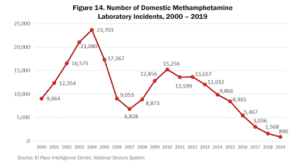
When ephedrine was readily available, small clandestine laboratories were found across the country. However, smaller labs have largely been replaced by transnational criminal organizations (TCOs) in Mexico, leading to a steady decline in domestic methamphetamine laboratory incidents, but an increase in seizures at the U.S. – Mexico border. Plus, the DEA reports that “many of the domestic methamphetamine laboratories seized in 2019 were small-capacity production laboratories, known as ‘one-pot’ or ‘shake and bake.’”
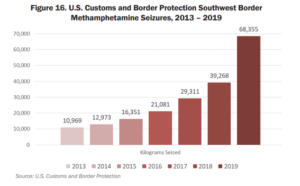
Methamphetamine seizures occur in every U.S. state. Mexican TCOs control wholesale methamphetamine distribution, while both Mexican and domestic criminal groups typically control retail distribution in the United States. The SWB remains the main entry point for the majority of methamphetamine entering the United States. Methamphetamine seizures along the SWB increased 74 percent from 2018 (39,268 kilograms) to 2019 (68,355 kilograms) (See Figure 16). Total nationwide methamphetamine seizures increased 77 percent between 2018 (41,396 kilograms) and 2019 (73,351 kilograms). While methamphetamine precursors are often transported via maritime shipments from China and India, finished methamphetamine is commonly trafficked overland across the SWB. Traffickers employ various techniques to transport and conceal methamphetamine, such as using human couriers, parcel services, and commercial conveyances. Commonly, traffickers transport multi-kilogram shipments of methamphetamine in privately owned vehicles. Fuel tank concealment remains a widely used technique with either packaged methamphetamine or methamphetamine in solution. Methamphetamine concealed in tires and other natural voids in vehicles are other popular methods for smuggling methamphetamine and other contraband into the United States.